What it takes to keep people exploring | Headout Hackin'
What if a guided tour felt more like a treasure hunt? Relic Quest adds a playful layer to Dex, inviting guests to spot, scan and solve their way through a venue while unlocking gems, relics and a more memorable way to explore.
A great tour can tell you where to go, explain what you are looking at and bring a place to life, but it cannot always stop you from becoming distracted, skipping a checkpoint or deciding that you have probably seen enough.
Dex is Headout's immersive guide for the world's most iconic venues. When we looked at how people moved through Dex tours, we noticed that the experience itself was not the problem. The audio was strong, the venues were remarkable and the stories were worth hearing, but there were still moments when people began to drift, usually because nothing was actively pulling them towards the next stop.
We began wondering what might happen if the tour did more than guide you through a place. What if it gave you something to pursue, a thread that continued from one checkpoint to the next and made completing the walk feel less like following instructions and more like unlocking something that belonged to you?
That question became Relic Quest, built during Hackin’ at Headout.
Turning a tour into a quest
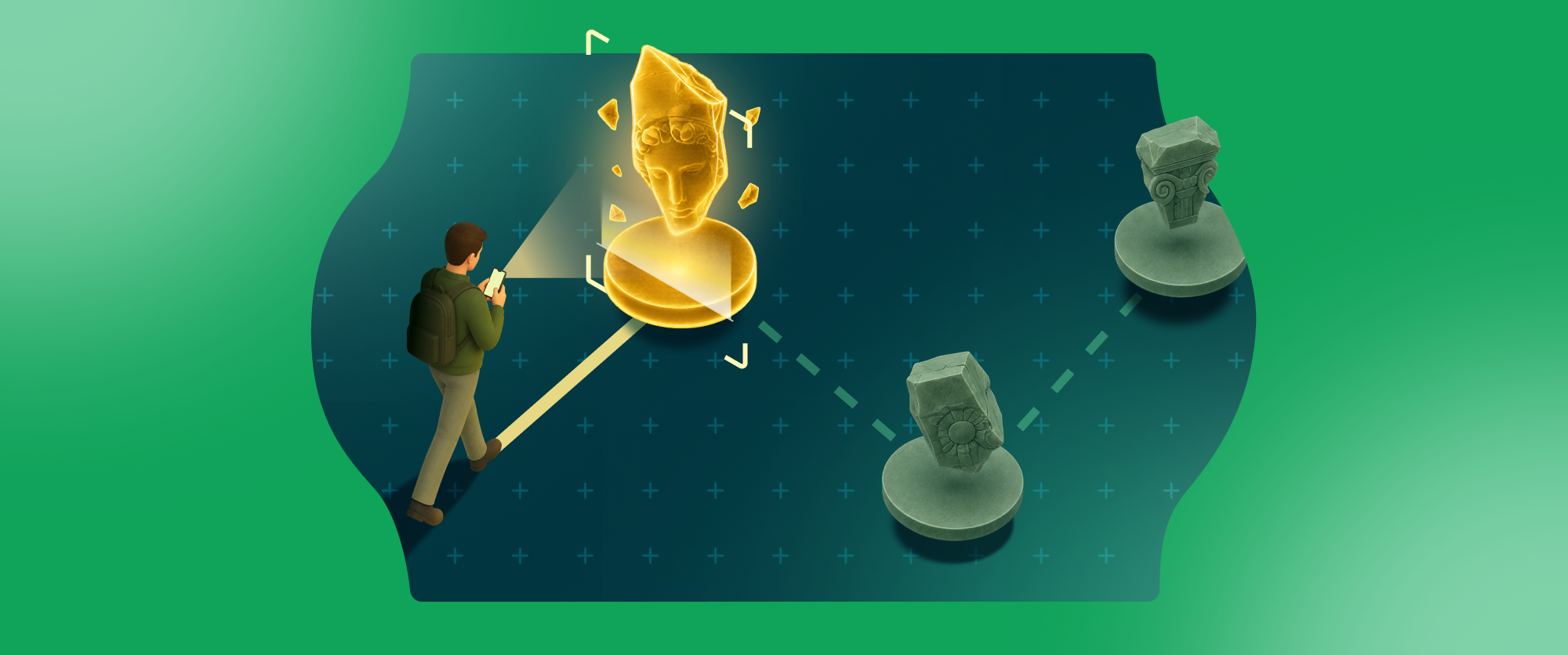
Relic Quest adds a lightweight game layer to Dex tours. As you move through a venue, the tour prompts you to complete small challenges: spot a particular detail, scan an object or answer a question based on what you have just discovered. Each completed challenge earns you a gem, and cracking open that gem reveals one piece of a collectible relic.
Complete every challenge during the tour and the full relic becomes yours, ready to display on your profile or share with friends. The idea is simple, but where those prompts appear makes a significant difference. Dex Studio tells us where the tour checkpoints are, while Mixpanel helps us understand where people tend to slow down, skip ahead or leave the experience entirely, which means we can place a challenge at precisely the point where curiosity might otherwise begin to fade.
A pause becomes a reason to continue, and once you have already collected three of five relic pieces, walking away from the remaining two becomes surprisingly difficult. It is part game design, part behavioural psychology and, perhaps, the sunk-cost fallacy wearing a particularly good disguise.
The idea behind the idea
Relic Quest began as two separate ideas. Rama from the team had been thinking about collectible relics that could become part of the tour experience, while Mukul had been exploring how augmented reality might make physical objects at a venue come alive on a guest’s phone.
The hackathon gave the team an excuse to bring those threads together, but the retention opportunity was what transformed the concept from an entertaining feature into something with broader potential.
Relic Quest does not only make one tour more engaging. It can make Dex more compelling across an entire destination. The Tower of London could have one relic, the British Museum another, and a Harry Potter neighbourhood walk a third. As guests complete more experiences, their collection begins to tell the story of how they explored a city, turning their profile into a record of places visited, challenges completed and relics earned.
That creates three connected behaviours: engagement within an individual tour, retention across several tours and a social layer that gives people something tangible to show for having completed the experience.
Building it in 42 hours
The team consisted of three people with clearly defined roles and very little time.
Suhas handled the engineering, wiring the feature into Dex’s existing action-node system so that relic prompts could be placed inside real tours without requiring the underlying tour infrastructure to be rebuilt.
Aromal created the relics themselves, including the 3D assets, badge designs and the visual identity of the objects guests would collect. He also built the pitch deck and appeared in the launch video, doing his best Tom Cruise impression while unlocking relics around the venue.
Mukul designed the interface, integrated each interaction into the existing Dex journey and produced a launch video that may have received an even bigger reaction during the presentation than the feature itself.
The most difficult part was making the AR scan work.
The phone needed to recognise a real object at a venue and display an animated 3D version of it, using assets that had not existed 30 hours earlier, all within the constraints of a hackathon. It was the kind of idea that remained slightly unbelievable until the live demo, when the scan fired successfully, the relic appeared and animated on screen, and everyone in the room could immediately imagine how the experience might feel inside a real venue.
The team published the build on Firebase and tested it inside Headout’s Bengaluru office. The interface, game logic, AR scanning, relic assets, Dex integration and launch video were all completed in under 36 hours.
Testing the psychology in the real world
Relic Quest is now heading towards a pilot at the Tower of London. Before it reaches guests, the experience needs to be prepared for production, the venue needs a complete and distinctive set of relics, and the team needs to analyse the tour data closely enough to identify exactly where an engagement prompt will be most useful.
The underlying bet is straightforward: when someone has already collected three of five pieces and the next one is only 200 metres away, they are more likely to keep walking. When their profile shows that they have completed four of six experiences across London, they may also have a stronger reason to return for the remaining two.
We built the proof in 42 hours. Now we get to find out whether the psychology holds in the wild.
Hackin’ at Headout is our internal hackathon, where small teams have less than two days to turn real business problems into working products. Interested in building with us? Explore open roles at Headout.