Mapping Museums without GPS | Headout Hackin'
What if creating immersive video for the world’s most iconic places could happen at scale? Panorama Llamas explores a faster, smarter production workflow that turns raw footage into rich visual experiences without slowing the team down.
Why a travel company was running robotics software
At midnight, our laptops began beeping. Not a notification beep, but the kind of thermal warning that suggests the fan has given up and the machine is reconsidering every decision that brought it to this moment. It was processing hours of 360° footage from a difficult corner of the National Gallery in London, running SLAM, the same family of algorithms used by autonomous vehicles and warehouse robots to understand where they are when GPS is unavailable.
The parameters had been adjusted and the job had been started. All that remained was to discover whether the result would be an accurate map of the gallery or a plate of spatial spaghetti. This is not a particularly normal thing for a travel company’s laptop to be doing in the middle of the night, but the problem that led there was becoming impossible to ignore as Headout built Dex into a companion for the world’s most iconic places.
Producers were doing the work of an algorithm
Every Dex guide begins with someone walking through a venue carrying a 360° camera, capturing the exhibits, corridors and transitions that will eventually become part of the guest experience. Once the footage comes back, a producer has to reconstruct the venue manually, working out where each important exhibit sits, how the rooms connect, what route a guest should follow and what they are likely to encounter along the way.
For a single venue, this can take several days. It also creates a slow and expensive feedback loop, because when the person on-site misses an exhibit or captures unusable footage, nobody discovers the mistake until much later, often after they have already left the venue or returned to another city. That process was manageable when Dex covered ten or fifteen venues. It was not going to survive a plan to scale across more than a hundred museums and attractions in a matter of months.
So, during Hackin’ at Headout, the team asked a question that sounded slightly unhinged but turned out to be useful: if robots can locate themselves inside buildings without GPS, why can’t a 360° camera do the same?
Two people and one broken fan
The team consisted of two people. Prasenjit on the spatial pipeline, running the footage through computer-vision and mapping algorithms to recover, frame by frame, how the camera had moved through the museum. From that, the team created a rough 3D reconstruction where a ghost of the camera could be seen retracing the route taken during the recce.
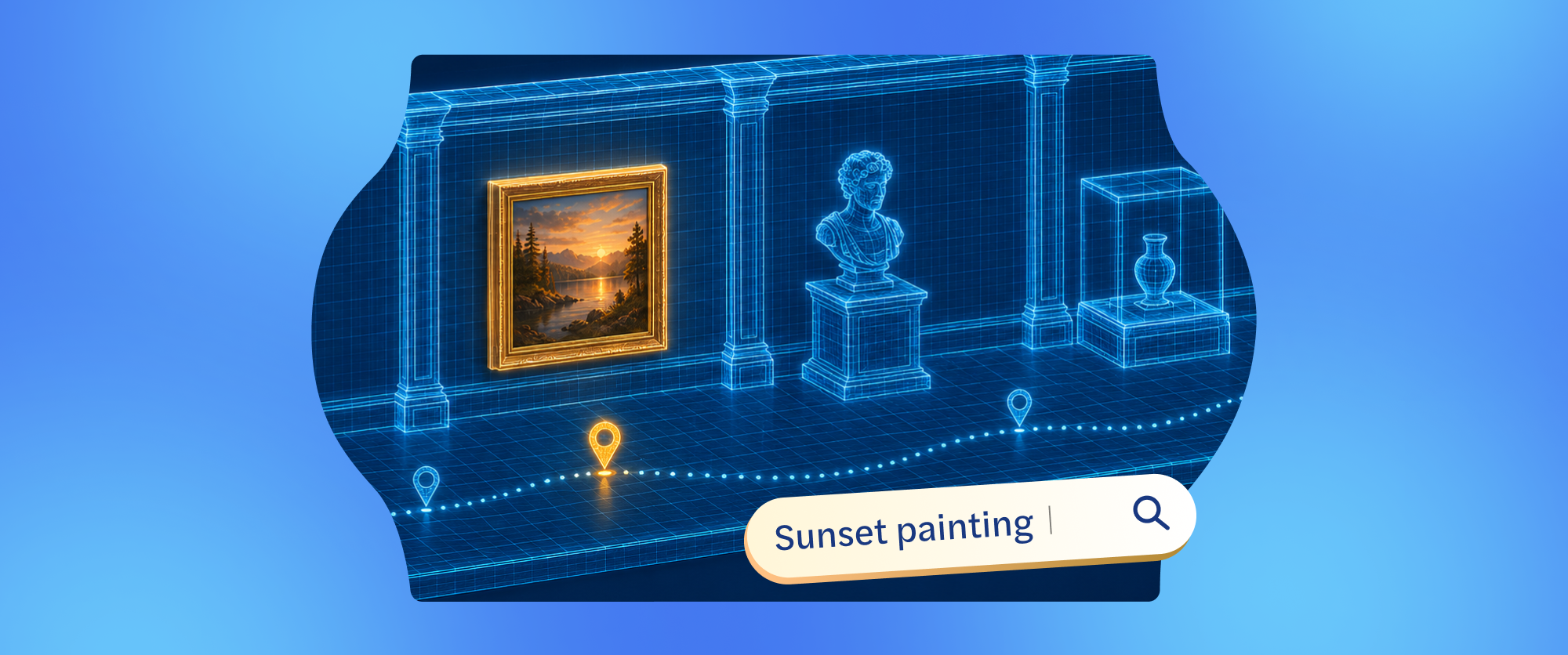
The system then detected the exhibits visible along that route and pinned each one to a position in the reconstructed space. Manas built the interface that made it feel like a real product rather than an impressive piece of technical plumbing: an immersive 360° editor where a producer could type the name of a painting and have the camera instantly move to the exact place where it appeared, with its location highlighted on the map.
Type a title, and teleport to the artwork. It looked slightly like science fiction, which was probably why the room leaned forward during the demo and why the project eventually won the hackathon.
The difficult part was the computation
The concept itself was not the hardest part. Running it in the time available was. The spatial processing required a significant amount of computing power, and there was not enough time during the hackathon to move the workload onto cloud infrastructure, so the entire pipeline ran locally on the team’s laptops. That is how the midnight thermal warnings began.
There were long stretches when it was unclear whether the parameters would produce anything useful, but when the reconstruction finally appeared, the camera path was remarkably accurate and the detected exhibits sat where they were supposed to. The prototype was not production-ready, but it provided something more valuable than a polished demo: a clear view of what the full system could become.
What this changes for producers
The immediate benefit is straightforward: producers no longer have to behave like human mapping algorithms. Instead of manually reconstructing a museum from hours of footage, they can begin with a spatial index and an exhibit map generated automatically, then use the editor to find, verify and sequence the locations needed for the guide. A task that currently feels forensic becomes much faster and more visual.
Eventually, the system should be able to process footage while the recce is still happening. The person standing inside the museum could be told, “you missed the Turner in Room 34,” before leaving the building rather than discovering the gap several days later. That closes one of the most frustrating loops in Dex production.
What this changes for guests
The larger opportunity begins once every venue has a usable spatial layer. When exhibits, cafés, toilets, entrances, exits and other amenities are pinned to real coordinates, Dex no longer understands only what a guest is hearing; it begins to understand where the guest is standing. That makes a question such as “where is the nearest toilet from here?” answerable with confidence.
It also creates the foundations for more useful navigation, more context-aware recommendations and an audio guide that can respond to the physical venue around the guest rather than behaving like a static track playing in the background. The same spatial index that makes production faster could make the finished product far more intelligent.
What happens next
The next step is to productise the system. The algorithms need to move to the cloud so they can process larger and more complicated venues, detection needs to expand beyond exhibits to cover amenities, and the spatial data eventually needs to flow into Dex so that it can power real-time answers for guests inside museums.
One thought stayed with the team after the demo. The people who developed these algorithms were probably thinking about robots, warehouse navigation and self-driving cars. They were unlikely to have imagined the same research being used to make the stories inside the world’s museums easier to build and easier to experience.
That is the fun of building at Headout: the problems are real, the room to experiment is wide, and two people with a hackathon weekend can pull an idea from a robotics paper into a travel product roadmap.
There is probably another useful idea buried in a research paper somewhere, waiting for the right problem, a deadline and, ideally, a laptop with a functioning fan.
Hackin’ at Headout is our internal hackathon, where small teams have less than two days to turn real problems into working products. Interested in building with us? Explore open roles at Headout.